Hardwood Floor Drying in Georgetown, TX
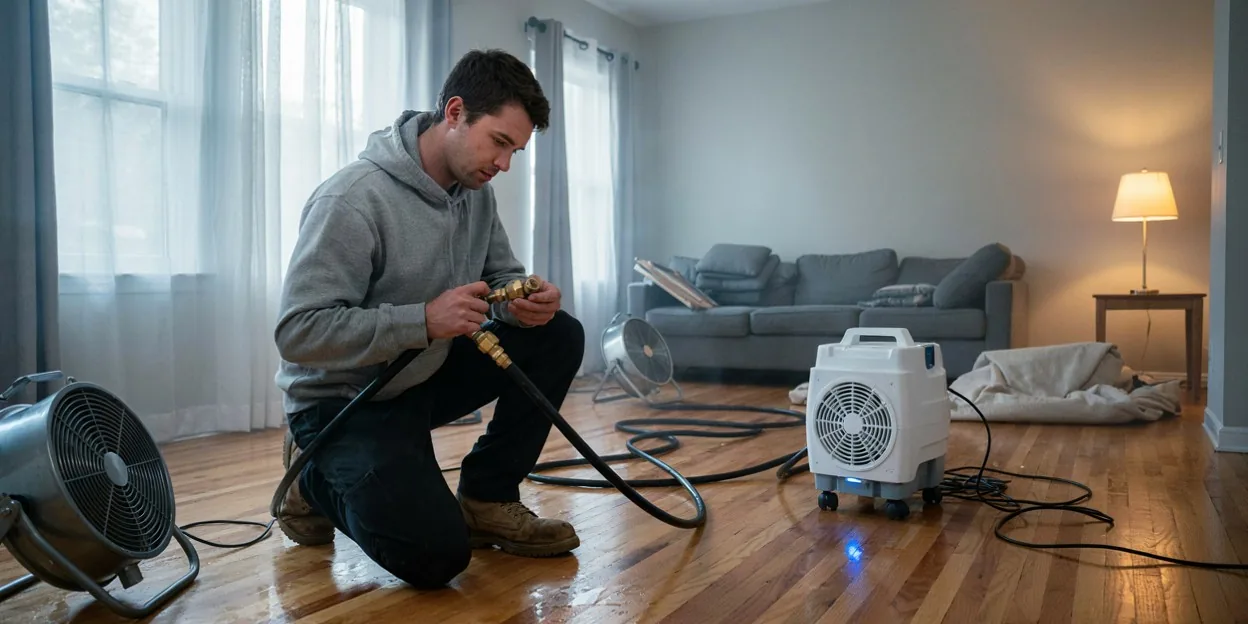
The dishwasher line dripped for a week behind the cabinet, and now the oak in the kitchen has ridges you can feel through a sock, each board humped at the edges and low in the middle. This site connects you by phone with an independent local provider who dries wood floors in Georgetown homes before the decision to tear them out gets made.
Reading the wood before judging the wood
The crew starts with a pin meter in the boards, at the worst spot and at a dry spot across the room, and then in the subfloor underneath if they can reach it. Cupping means the bottom of the board is wetter than the top, so the number that matters is the one from below. On a slab house they read the board and the slab. On a pier-and-beam house they go into the crawl space and read the subfloor from underneath.
Then the mats go down. Floor-drying mats seal to the surface and pull air through the boards from the top, while a dehumidifier takes the moisture out of the room. The crew reads the wood every day and writes the number down. When the boards get within a point or two of the dry reference, the mats come up. If the readings stall, that is the answer, and the floor comes out.
Towels now, no fans yet, and do not sand anything
Get the standing water off the surface with towels or a squeegee. Do not aim a box fan at a wet wood floor; drying the top faster than the bottom makes the cupping worse. Do not call a floor refinisher yet, because sanding a cupped floor that is still wet leaves a crowned floor once it dries. Photograph the ridges with a straightedge across them so the adjuster can see the height. Then call.
What a wet floor gives back and what it keeps
Solid wood, including the long-leaf pine in Georgetown's older houses, has the most to give back. Boards that have cupped but not buckled off the subfloor often flatten to where a light sanding finishes the job. Engineered plank with a thin veneer is a harder case, and once the veneer separates from the core it is done. Laminate is not wood and does not recover; it comes out.
The subfloor matters as much as the boards. Plywood dries; particleboard swells and stays swollen. If the water came from a source that was not clean, the floor comes out regardless, because sewage cleanup does not dry contaminated wood in place. If the boards are sitting over a wet crawl space, crawl space water extraction has to run at the same time or the floor keeps drinking from below.
Pine floors over crawl spaces and plank floors over slabs
Georgetown's floors split by neighborhood. In the Belford and University Avenue districts, the floors are original long-leaf pine on pier-and-beam framing, and water that hits them goes through to the crawl space. Those floors have survived more than a century of Texas humidity, and they can survive a wet weekend if the crawl space dries with them.
In Sun City, Berry Creek, and Wolf Ranch, the floors are engineered plank or solid oak glued or nailed over a slab. A slab leak wets those floors from below with no warning until the boards lift, and a washer or a water heater wets them from above. Either way the slab holds moisture for weeks after the surface looks dry, so the readings continue after the boards look flat.
A cupped floor from a sudden leak is often a covered loss under a Texas policy, and a floor that swelled over months from a slow drip is often not. Ask the crew to log the readings from the first day, because an adjuster is more likely to pay for drying than for a new floor when the drying log shows it worked. If the floor does come out, water damage reconstruction covers putting a new one down after the subfloor is dry.
Call while the boards are still only cupped
Have the address ready and say what kind of floor it is, where the water came from, how long it ran, and whether the boards are cupped, lifting, or buckled. Say if the house is pier-and-beam. Call (512) 399-1654 and we put you through to a local provider serving Georgetown and northern Williamson County.