Washing Machine Overflow Cleanup in Georgetown, TX
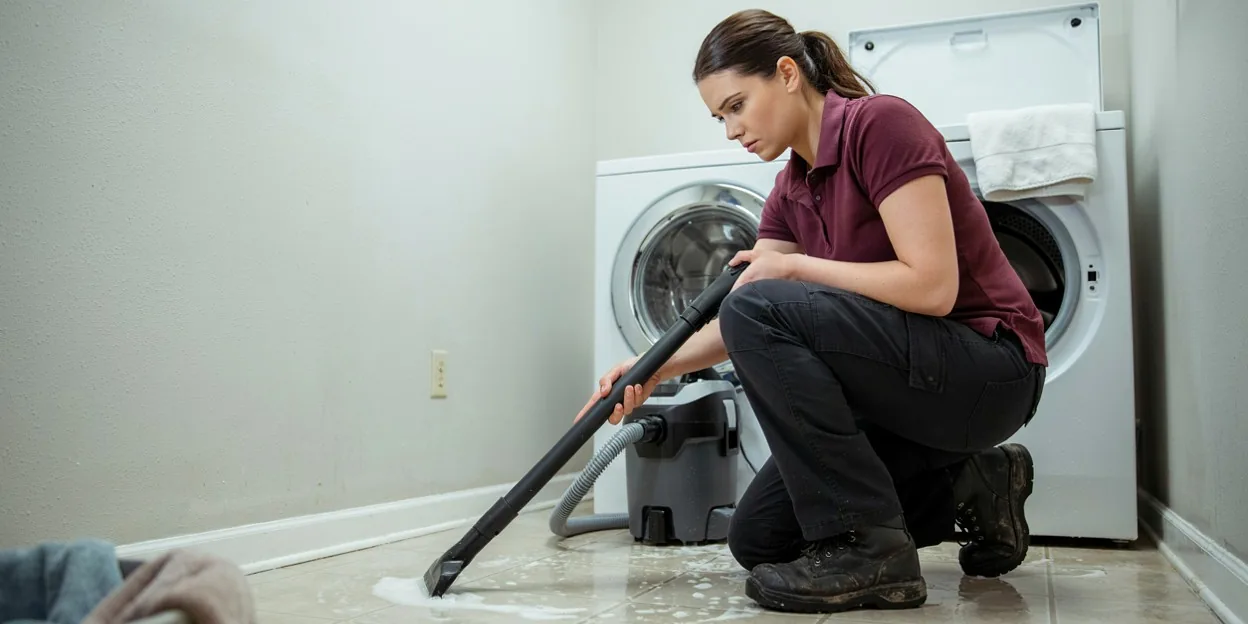
You ran a load before leaving for the grocery store, and when you came back the laundry room door was swollen shut and water had crossed the hall into the guest room carpet. This site connects you by phone with an independent local provider who cleans up after washer floods in Georgetown and the towns around it.
Following the water out of the laundry room
The crew confirms the washer valves are closed and then finds out how the water left the room. A laundry room in a Georgetown slab house usually has a tile or vinyl floor with a small lip at the door, and once the water tops that lip it runs into the hall carpet and under the walls on either side. In a two-story house the laundry room is often upstairs, and the water finds the ceiling below through the drain and the seams in the subfloor.
They pull the water with an extractor, then meter the laundry room walls, the hall, the closet on the other side of the wall, and the ceiling below if there is one. The pedestal or the platform under the washer gets pulled if it is particleboard, because it soaks and swells. Drying gear goes where the readings say, and the readings get logged every day.
Close both valves, unplug the machine, and check the room below
Turn off both supply valves behind the washer, hot and cold. Unplug the machine or turn off its breaker. If the laundry room is upstairs, go downstairs and look at the ceiling; if it is sagging, stay out from under it. Pull anything off the floor that you can, including the laundry basket, and photograph the water, the machine, and the hose. Then call.
Hoses fail fast; standpipes fail slow
A rubber supply hose that bursts moves a lot of water in the time it takes to notice, and the loss is usually clean water on a floor that dries well once the pad is out. A clogged standpipe or a drain hose that jumped out of the pipe overflows a little on every load, and by the time the floor changes color the drywall behind the machine and the subfloor under it have been wet for weeks. The first is water extraction and drying. The second often means the wall behind the washer opens.
Vinyl and tile floors in the laundry room usually stay. Hall carpet dries if the pad comes out the same day. A wood floor in the hall gets metered and, if it is cupping, hardwood floor drying puts mats on it. If the drain hose was the source and the water came back up from the standpipe, the crew treats it as gray water and pulls the porous materials it touched.
Laundry rooms off the garage, and laundry rooms over the living room
Georgetown's single-story houses, most of Sun City among them, put the laundry room between the garage and the kitchen, and the water goes into the kitchen cabinets on one side and the garage on the other. The garage slab wipes up. The kitchen cabinets do not, and the crew pulls the toe kicks to meter the cabinet bases before deciding what stays. In the two-story houses of Wolf Ranch, Parkside on the River, and Berry Creek, the laundry is upstairs, and the loss becomes a ceiling and a downstairs wall as well.
Georgetown's water is hard, drawn from Lake Georgetown and the Edwards Aquifer, and hard water shortens the life of a rubber hose and scales up a standpipe. Braided steel hoses and a standpipe cleaning every few years prevent most of these calls. A house that sits empty, whether a Sun City home during a summer away or a rental between tenants, is where a hose failure runs the longest.
A burst hose is a sudden loss that many Texas policies respond to. A standpipe that overflowed for months is the kind of slow leak an adjuster may call gradual. Ask the crew to photograph the hose or the standpipe before it gets fixed and to log the readings from the first day. If the ceiling below came down, water damage reconstruction puts it back after the framing is dry.
Call about the laundry room that would not open
Have the address ready and say whether the hose burst or the drain overflowed, which rooms the water reached, whether the laundry room is upstairs, and whether the valves are off. Call (512) 399-1654 and we put you through to a local provider serving Georgetown and northern Williamson County.